A World That Never Shifted
Imagine looking at Earth from space.
You still see oceans.
You still see land.
But something feels strangely frozen.
No drifting continents.
No rising mountain ranges.
No opening or closing oceans.
It’s easy to think of plate tectonics as just earthquakes and volcanoes. But in reality, plate tectonics is the slow engine that reshapes Earth’s surface, regulates its climate, and supports long-term life.
Without it, Earth would not simply be quieter.
It would be fundamentally different.
What Plate Tectonics Actually Does (In Simple Terms)
Plate tectonics is the movement of large slabs of Earth’s crust over the softer mantle beneath.
These plates move only a few centimeters per year—but over millions of years, that motion changes everything.
Plate movement causes:
- Continents to drift
- Mountains to rise
- Oceans to open and close
- Crust to recycle into the mantle
It’s like a conveyor belt for the planet’s surface.
Without this system, Earth becomes geologically static.
Why Plate Tectonics Started in the First Place
Early Earth was hotter than it is today.
That heat made the mantle more flexible, allowing the rigid crust above it to crack into plates and begin moving. Water also played a crucial role by weakening rocks, making motion easier.
Once plate tectonics began, it became self-sustaining:
- Heat escaped more efficiently
- Crust recycled instead of piling up
- Earth avoided becoming geologically “stuck”
If plate tectonics had never started, none of this balancing would occur.
A Planet With One Giant, Unbroken Crust
Without plate tectonics, Earth’s crust would likely be a single, thick shell.
That means:
- No continents drifting apart
- No collisions to build mountains
- No deep ocean trenches
Land would still exist—but it would be flatter, older, and far less diverse in shape.
The dramatic landscapes we recognize today depend on moving plates.
Mountains Would Be Rare and Short-Lived
Most major mountain ranges form when tectonic plates collide.
Without plate tectonics:
- No Himalaya-style collisions
- No Andes rising along plate edges
- No fresh mountain-building events
Erosion would slowly wear down existing highlands, and nothing would replace them.
Over time, Earth would become smoother and more uniform.
Climate Regulation Would Break Down Slowly
Plate tectonics plays a quiet role in climate stability.
Here’s how:
- Uplifted mountains increase weathering
- Weathering removes carbon dioxide from the atmosphere
- Subducted crust returns carbon to Earth’s interior
- Volcanic activity releases it back slowly
This long-term carbon cycle acts like a thermostat.
Without plate tectonics:
- Carbon recycling slows dramatically
- Climate becomes harder to regulate
- Earth could drift toward extreme heat or cold over millions of years
The danger isn’t sudden—it’s gradual imbalance.
Oceans Would Become Chemically Different
Seafloor spreading constantly creates new ocean crust.
This process:
- Regulates ocean chemistry
- Controls nutrient availability
- Supports long-term ocean circulation
Without it:
- Ocean floors become very old
- Chemical exchanges weaken
- Nutrient cycles slow
Life in the oceans would persist—but ecosystems would become simpler and less productive over time.
Life Might Exist — But Evolution Would Slow
Life does not require plate tectonics to exist.
But complexity does.
Plate tectonics creates:
- Isolated environments
- Changing coastlines
- Shifting climates
- New ecological niches
These changes drive evolution.
Without tectonic movement:
- Fewer environmental challenges
- Slower diversification
- More stable but less dynamic ecosystems
Life adapts best when the environment changes just enough.
A Common Misunderstanding: “Plate Tectonics Is Just Destructive”
Earthquakes and volcanoes feel disruptive on human timescales.
But on planetary timescales, plate tectonics is constructive.
It:
- Recycles nutrients
- Prevents crustal stagnation
- Maintains surface diversity
- Supports long-term habitability
Destruction is part of renewal.
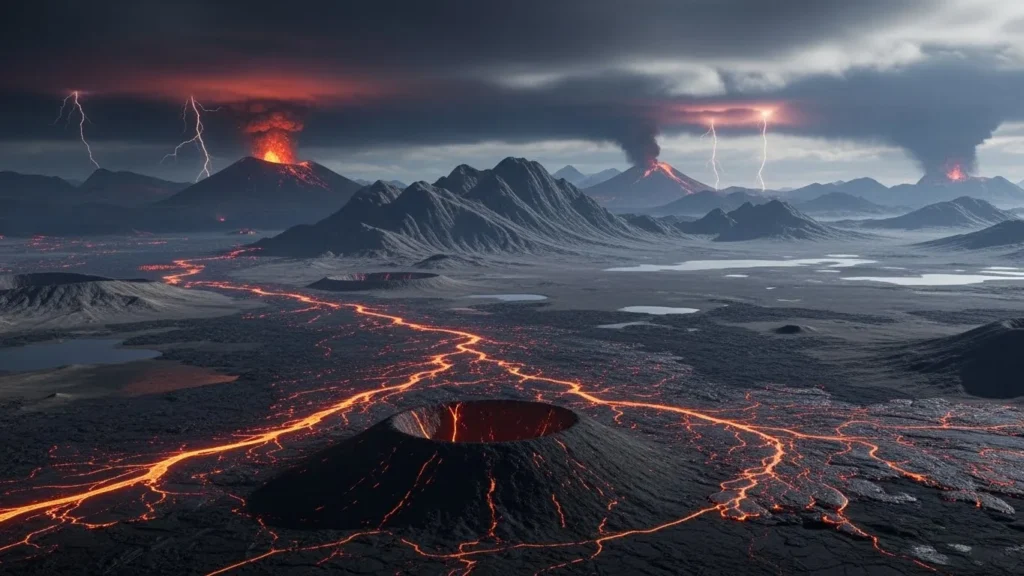
Earth Might Start to Resemble Mars or Venus
Mars and Venus lack active plate tectonics.
As a result:
- Heat builds up inside
- Crust thickens
- Surface renewal slows
Earth without plate tectonics could follow a similar path—becoming geologically quieter but less capable of supporting complex life over time.
A Simple Comparison
| Feature | Earth With Plate Tectonics | Earth Without Plate Tectonics |
|---|---|---|
| Surface Change | Continuous | Minimal |
| Mountain Building | Ongoing | Rare |
| Carbon Recycling | Active | Weak |
| Climate Stability | Long-term balance | Gradual extremes |
| Evolutionary Pressure | High | Reduced |
This comparison shows why motion matters more than it seems.
Why This Matters Today
Understanding plate tectonics helps explain why Earth is different from other rocky planets.
It reminds us that:
- Habitability depends on deep, slow processes
- Stability comes from motion, not stillness
- Earth’s livability is not guaranteed—it’s maintained
Plate tectonics is one of the quiet reasons Earth remains alive rather than frozen in geological time.
Key Takeaways
- Plate tectonics reshapes Earth’s surface continuously
- It supports long-term climate regulation
- It creates landscapes and biodiversity
- Without it, Earth would be flatter and less dynamic
- Movement, not stillness, sustains planetary balance
Frequently Asked Questions
1. Could Earth exist without plate tectonics?
Yes—but it would be far less dynamic and less suitable for complex life.
2. Are earthquakes necessary for life?
Not directly, but they are part of the tectonic system that supports habitability.
3. Did plate tectonics start immediately after Earth formed?
No. Evidence suggests it began after Earth cooled sufficiently.
4. Do other planets have plate tectonics?
So far, Earth is the only known planet with active plate tectonics.
5. Is plate tectonics still active today?
Yes. Plates are still moving, just very slowly.
A Calm Conclusion
Plate tectonics doesn’t announce itself.
It moves silently, reshaping continents grain by grain, year by year.
Without it, Earth wouldn’t collapse—but it would slowly lose the diversity, balance, and adaptability that make it feel alive.
Sometimes, the most important forces are the ones that never stop moving—even when we can’t feel them.
Disclaimer: This article explains scientific concepts for general educational purposes and is not intended as professional or medical advice.